|
This page was last updated: 10/21/10

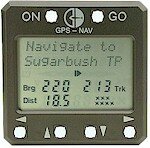
GPS Navigator and Secure Flight Data Recorder
GPS-NAV Demo Program Available
The GPS-NAV demo is again available. while it is not the latest version, it will give you an idea of how the instrument works. You will need to unzip the file in a temp folder and use your browser the view the demo. See the README.txt file for instructions. Click here to download the file.
The Latest Release, Version 6.0
We have made some significant changes to the GPS-NAV firmware. Please see the list below for details.
Pressure altitude is sent from a non-activated GPS-NAV to the Pocket-NAV.
This feature enables pilots to show differential final glide altitude when Pocket-NAV Version 4 is used with a non-activated GPS-NAV.
GPS Satellite data is added to messages sent from GPS-NAV to Pocket-NAV.
This features helps GPS problem diagnosis when Pocket-NAV Version 4 is used.
Data synchronization is improved for messages between GPS-NAV and Pocket-NAV.
Previous versions occasionally stopped sending messages between the GPS-NAV flight recorder, the GPS-NAV LCD screen, and the Pocket-NAV.
Removes a bug that caused intermittent failure of manual fast logging.
When the ON key is pressed during flight, a PEV mark is added to the flight log. The GPS-NAV flight recorder is supposed to then log 15 points at 2 second intervals. Version 6 firmware fixes a bug that occasionally caused this to not happen.
Removes a bug that rarely caused the arrival beep to occur outside the arrival radius.
Earlier versions truncated a number indicating distance to the goal point. In very rare instances, this caused the GPS-NAV to display the "Arrival" message before the arrival distance was achieved. The error could be up to 100 meters. This computational problem has been solved.
GPS-NAV Upgrade Pricing:
| From any version to V5.1 |
No Charge |
| V5.1 to V6.0, includes Barograph Calibration |
$125.00 |
| Without Barograph Calibration |
$95.00 |
| V5.4 / 5.5 to V6.0, includes Barograph Calibration |
$105.00 |
| Without Barograph Calibration |
$75.00 |
| |
|
The GPS-NAV must be returned to the Factory or a Cambridge Aero Service Dealer for the upgrade.
There in no upgrade for the GPS-NAV Display.

Version 5.5:
During the beta testing phase of Pocket-NAV development a bug was found in the GPS-NAV firmware. When the Flight Recorder is running with a Pocket-NAV and GPS Display connected, there will be occasional interruptions of the NMEA data transmission to the L-NAV and the Pocket-NAV. These interruptions may last for up to 45 seconds. The Symptoms: On the L-NAV, Pocket-NAV and GPS Display, distance and bearing will not update for the period of the interruption. On the L-NAV, the interruption can be long enough for the L-NAV to display "GPS OFF". The L-NAV can mysteriously return to the main flying screen during an interruption. If you are flying with only one of the displays connected to the FR this bug will not happen.
Bug List for Version 5.5:
Pilot Event Marker. When using a GPS-NAV containing an eight channel receiver: every other initiation of a PEV the logging may become erratic. With a 12 channel receiver: logging rate will be as expected the first time and every other time after initiation of a PEV. All the even PEV's may default to the GPS-NAVs configured slow logging rate.
Version 5.4 Released:
This version includes the IGC required "Event Marker" as well as Pocket-NAV compatibility. Below are the features of this new version.
This ROM Version adds the following features to the Cambridge GPS-NAV:
1. The IGC-mandated "Pilot Event Mark"
2. Software support for the Cambridge Pocket-NAV moving map display
3. Password protection for Cambridge Pocket-NAV software
4. Battery power support for the Pocket-NAV
5. Minor software "bug" fixes.
1. The IGC-mandated "Pilot Event Mark"
Please note: The GPS-NAV PC Software V5.6 does not display the pilot event marker. The next release will.
All IGC-Approved Secure Flight Recorders are required to support a "Pilot Event Mark" (PEV) for use at the 1999 World Gliding Championships in Bayreuth, Germany. The intended use is for pilots to mark their starts. Version 5.4 GPS-NAV does this in the following way:
A PEV is entered in the flight log when the GPS-NAV "ON" key is pressed or when a TASK is started. The PEV also causes a normal position fix to be logged within 2 seconds. The position fix contains GPS time and pressure altitude as well as GPS position, so it completely documents the PEV. Fifteen fixes at 2 second intervals are logged after the "ON" key is pressed.
The GPS-NAV give a short audio "beep" when the PEV is logged. This confirms the PEV. The GPS-NAV LCD screen sequences through a series of messages when the "ON" key is pressed. Pressing the "GO" key cancels the message sequence.
The GPS-NAV used without an LCD screen also supports the PEV feature. A pushbutton switch attached to a six conductor cable is plugged into the GPS-NAV "Display" port. Pressing the button is the same as pressing the LCD screen "ON" key. Cables may be purchased from us or you may fabricate your own. See the instructions for further details.
2. Software support for the Cambridge Pocket-NAV moving map display
GPS-NAV Version 5.4 sends Barograph Altitude to the Pocket-NAV. The Pocket-NAV sends Tasks and Declarations to the GPS-NAV. The Pocket-NAV receives air data and polar curves from L-NAV Version 5.6 or S-NAV Version 7.6/8.6 via GPS-NAV Version 5.4.
3. Password protection for Cambridge Pocket-NAV software
Pocket-NAV software is the intellectual property of Cambridge Aero Instruments. Software development and support is expensive. Because illegal copies of Pocket-NAV software can be made easily with a PC, Cambridge has chosen to protect its intellectual property rights with passwords stored by GPS-NAV Version 5.4 firmware. The password system is based on the GPS-NAV serial number. This system is designed for future low-cost Pocket-NAV upgrades via the Cambridge Aero Internet Website.
4. Battery power support for the Pocket-NAV
Palm-size-PCs running windows CE have reasonable battery life when used without serial data communication. The Cambridge Pocket-NAV requires continuous serial communication with the GPS-NAV. Palm-size-PCs have very short battery life when operated this way. Therefore, Cambridge GPS-NAV Version 5.4 supplies +5 Volt power to the Palm-size-PC via serial datacom cable pin 8. Pin 5 is the power supply ground.
5. Minor software "bug" fixes.
a. Short logging interval for Navpoints more than 300 km distance.
If the GPS-NAV is set for variable rate logging, and if the active Navpoint is more than 300 km away, then the GPS-NAV logs extra fixes at the fast interval. On a very long flight logged at 6 and 2 second intervals, the GPS-NAV can run out of memory. This problem has been solved in
Version 5.4
b. Leap Year bug.
This problem was discovered during an investigation for possible Y2K problems. No Y2K problems have been found. However, If a flight log is being recorded at midnight UTC, December 31 at the beginning or end of a leap year, the flight log is divided into two parts. This problem has been solved in Version 5.4.
c. Behavior with Westerboer 921 Glide Computer
Earlier GPS-NAV versions left information not required by Cambridge Aero Flight Computers out of transmitted NMEA sentences. This causes problems with the Westerboer flight computer. Version 5.4 transmits complete NMEA $GPRMB and $GPRMC sentences.
Version 5 Hardware and Software
New Version 5 PC Software:
Simplified GPS Navigation - The easiest gets even easier!
 |
Select any of 250 navigation points in less than 7 seconds. |
|
Edit an active task - great for P.O.S.T. |
|
See intermediate distances during task editing. |
|
Try alternate tasks while preserving a declaration. |
|
More robust and reliable circling wind measurement |
New 12 channel GPS - the best GPS engine available
|
Very fast satellite acquisition |
|
Improved signal-to-noise ratio so antenna location is less critical |
|
Faster track and groundspeed update - roll out of a thermal exactly on track |
Improved Navigation Point database integrity!
|
Critical navigation data is now stored in duplicate. |
|
Error correction algorithms maintain database integrity. |
|
Improved PC - Flight Recorder data communication reliability |
Improved Flight Logging - We learn from experience!
|
Synchronized Arrival message - no more missed turnpoints |
|
Automatic variable rate logging - Store up to 120 flight hours! |
|
Manual fast logging when you want it - just push the ON key |
New Accessories - make our products even easier to use
|
GPS NAV External Power Pack & cable (10 hours minimum) - $75 |
Low cost upgrades - we take care of you on the ground and in the air!
|
Version 5 GPS-NAV LCD Screen ROM upgrade - $75 |
|
Version 5 PC software- $47 |
|
Barograph re-certification - $75 |
|
8 channel to 12 channel GPS engine upgrade - $350 |
Cambridge Aero Instruments GPS-NAV is CE certified.
Background:
Cambridge pioneered Secure GPS Flight Recording and Navigation with the introduction of the Model 10. This was the first GPS based Flight Recorder to score a World Championship. It was first to receive FAI approval. The Model 10 set the standard for all to follow.
State of the Art Secure Flight Recording and Navigation:
Our GPS-NAV Model 10 has been a proven success since 1993. Now Cambridge re-defines state of the art. The Model 20 and 25 use the latest technology and eliminate the Model 10's internal battery. This reduces both size and cost. All GPS-NAV models have the same functionality and are approved for validation of FAI Badge and Record flights.
Better by Design:
Cambridge systems are designed by glider pilots for glider pilots. The FAI approved GPS-NAV replaces both cameras and barographs. Ease of use and attention to detail make Cambridge the best GPS system for soaring.
Model 20
The Model 20's small package features a built in antenna, allowing easy installation and removal. Using the same 1/4"-20 mounting screw as a camera allows simple attachment to a standard camera mount. The small size also permits installation on or just under the instrument panel cover. |
 |
| Current: |
150 mA @ 12V |
| Size: |
4.7" x 2.7" x 2.0"
120mm x 68mm x 51mm |
| Weight: |
13 oz. (.36 kg) |
| |
|
|
Model 25
For more difficult installations the Model 25 features a standard BNC connector, rather than a built-in antenna. This allows any standard GPS antenna to be located remotely and connected to the Recorder via a coaxial cable.
|
 |
| Current: |
150 mA @ 12V |
| Size: |
4.7" x 2.7" x 2.0"
120mm x 68mm x 51mm |
| Weight: |
13 oz. (.36 kg) |
Wind Strength and Direction:
|
Computed from position drift during circling flight |
|
Locates wind shear and blue streets |
Custom Navigation Point Lists:
|
Create, edit and import multiple navigation point lists with a PC |
|
Feature-rich database includes field elevation and text comments |
Secure Flight Recorder:
|
Automatic, motion based flight recording |
|
Fully approved for FAI Badge and Record flights |
|
FAI approved pressure barograph |
|
FAI approved motorglider engine run sensor |
Flight Analysis with 4 Second Resolution:
Cambridge flight analysis brings a whole new dimension to soaring. Flight logs from a contest can be transferred to the PC and checked in less than two minutes. Up to 11 hours of flight at 4 second intervals are displayed. Every aspect of soaring flight is shown in amazing detail. The color display shows, for the first time, differences in technique and strategy that separate the winners from the also-rans. This is both entertaining and valuable in all levels of training, from beginner to world team pilot.
We've traveled the gliding world and gained vital experience on the flight line:
|
1995 WGC - 900 flight logs
- 0 failures |
|
70+ GPS-NAVs - 1996 Europeans
- 0 failures |
|
90+ GPS-NAVs 1996 pre-Worlds
- 0 failures |
|
1997 NZ and Australian Nationals
- 0 failures |
|
1996/1997 South Africa - more than 25 world records
- 0 failures |
Back to Top
|
 ® CAMBRIDGE Aero Instruments